Thursday, 7 July 2016

MacBook 2015 a Photographer's Field Dream

Originally posted May 18th, 2015

In a world where the photographer is looking to travel lighter, mirrorless cameras have made a big impact. We can now go out into the street and the field with a whole kit in a small shoulder bag rather than a large packsack. This miniaturisation has allowed more discrete street photography without compromising quality. Landscape photographers are able to travel lighter and I would think to get farther and deeper into the scene. If you are one of these photographers then an important issue, when travelling, is the need to stay connect and likely do some minimal post processing to ensure the capture you got during the day was worth the expense of your trip. Up until now the best way to do this has been either an iPad or perhaps a small MacAir, I can’t speak to the alternative universes of PCs, chrome books, or tablets I will leave that up to someone else.
The new MacBook is so miniaturised that almost makes an iPad out of a laptop. Which makes one think if I need to replace my iPad or my MacAir, would this new device be a better investment? Could it replace either device as the ultimately miniaturised device for a photographer in the field? So what are the issues with this machine?

The Single Plug

The Macbook has only one peripheral port, no USB, no VGA, no SD, just a USB-C port capable of connecting both power and peripherals. The computer comes with a power cable, so to do anything else you need purchase an additional USB-C adaptor. There are three the largest is a three-way adaptor, from which you can power the device, connect a TV and one USB device. However in the field I think most photographers would simply use the power cord while working and if wanted to download an SD card simply disconnect the power cord and connect the much cheaper USB-C to USB adaptor. Into this, you would connect a USB to SD adaptor that most people likely already own. So really you are only carrying one additional very small $25 connector. If this is your field computer, this arrangement would not really present problems. With this computer, you would not need a lot of peripherals in the field, as the hard drive on the computer is large enough to provide the necessary backup to your SD cards.

Is the Processor Robust Enough?

I spoke with the local Apple sales representatives about how this computer fits into the lineup. They told me it had a slower processor than the MacAir and the Mac Pro, and so was targeted towards users that don’t do any “heavy lifting.” This immediately raised the issue of how well would it run Lightroom 6? Some “googling” on the topic netted a video demonstrating how quickly it moved from image to image, this demonstration ran without a hitch and another review that suggests that there were no problems running both Lightroom and Photoshop.  In general, there did not seem to be a problem with the processor and Lightroom. There were also some other reviews warning that you could not really make this computer your home computer and do extensive photography work on it, something this article is not contemplating. So it would seem there is more than enough processor to drive Lightroom. However I would not recommend merging nine 56 megapixel files into an HDR file, that might not be within the capacities of this machine.

Size

If you look at the table below you will see that the iPad is not significantly smaller than the MacBook. The MacBook is wider and deeper but this does mean you are getting more screen real-estate, which is important when examining your day’s capture. It is twice the weight of the iPad, but the upside you have a keyboard, a very useful tool for those of us touch typists who are updating our blogs in the field; I think this is better than throwing a keyboard into your suitcase for the iPad. In addition to the screen size and keyboard, it is a great deal more versatility since an iPad is not a computer. So I think given its size it could fit nicely into a small bag in much the same fashion as an iPad would. (You will notice I have overlooked the MacAir 11″ as I find this just too small for doing any real work.)

Cost Comparison to the MacAir

Finally, what about the cost are you getting the best deal as the MacAir is much cheaper and the MacBook Pro has a faster process and is the same price? If you look at the chart above you will see that the MacAir only has 4Gigs of RAM compared to the MacBooks 8Gigs, furthermore the MacAir’s SD drive is only 128Gigs compared to the MacBooks SD drive of 256Gigs. If you bring the MacAir up to 256Gigs you begin to close the price gap, but you can not upgrade the SD drive, despite the fact that the MacBook can be upgraded to 512Gigs. In addition, MacAir does not have a Retina screen. Given the enhanced SD drive, Retina screen and enhanced RAM and the ability upgrade the SD drive the MacBook does seem to be more of a bargain than the MacAir, even though it is more expensive. Keep in mind it MacBook is also lighter and smaller.

Comparison to the MacBook Pro

The MacBook Pro also comes with a smaller SD drive but this can be upgraded, however, once you upgrade the drive it becomes more expensive than the MacBook. It is also twice as heavy and more than twice as thick. Portable here is compromised as it is not going to fit into a small bag and is much further away from the size of an iPad than would be desirable. I think it is safe to say if you only want one computer for home and the field this would be a good purchase. However if you already have a home computer and you need either an iPad or lightweight field computer, the MacBook Pro is definitely not something to consider and price wise it is more expensive.

Conclusion

The MacBook looks like it could very well be the photographer’s dream, lightweight but still having all the attributes of a computer. In addition, I think if one has an iPhone 6+, which as its’ owners know means you are consulting you iPad far less than you used to. This might mean you could use this laptop for dual purposes both in place of the iPad and  a field computer to do your post processing and keeping up with your social media.

Sony A7 Series a Contemplation

Originally Posted April 26th, 2015

Sony has been producing full frame mirrorless interchangeable cameras since October 2013, prior to this time, the only full frame mirrorless camera was a Leica rangefinder which started at $6000. Since 2013 Sony has produced and A7 (now selling at $1500), the A7R $2300 in Oct 2013, the A7S $2500 in April 2014 and then the A7II in November 2014 $2000. In one year they have created a low light 12-megapixel camera the A7S, a 24-megapixel camera with 5 axis image stabilisation and their high resolution 36 megapixel A7R. A range that makes it quite difficult to choose, if you are looking at investing in a full frame mirrorless. A good discussion on the implications of resolutions can be found in Nasim Mansurov’s article Camera Resolution Explained.

Why Not Switch to Full Frame Mirrorless

Mirrorless cameras are lighter and sometimes more internet savvy than DSLR cameras, still, Nikon and Canon sell a lot of DSLR cameras. These mirrored cameras are much larger and more difficult to carry around so why hasn’t everyone been converting to Sony’s smaller lighter mirrorless cameras. Well, the first issue that is always raised is the speed and accuracy of autofocus for things like wildlife and sports photography. The experts have been dissecting this issue and in general agree that the difference is very close, unless of course you are shooting professionally and then there are some fine differences that are important. So if you are a very serious sports or wildlife photographer mirrorless cameras might not be for you.
The more important issue is around lenses, as lenses are always the first consideration when you are looking at purchasing a camera. When you purchase a camera you are locking into a manufactures lenses and any third parties that might be produced for their lens mount. Again wildlife and sports photographers have found a poor selection of telephoto lenses and this coupled with the focusing issue keeps them mostly in the DSLR world.

Landscape Photographers and Mirrorless

Landscape photographers, however, don’t really have a big issue with the autofocus nor the telephoto problem. They tend toward wider angle prime lenses and tripod situations, occasionally using a telephoto lens. So for these photographers and I think the street photographers who greatly benefit from a smaller camera kit, a mirrorless full frame is a much better solution than a DSLR. So the question for these photographers is are there enough high-quality prime lenses.
I think the answer here is yes. The following lenses are an edited list of what appear to be the best options in terms of optic quality and integration with the Sony A7 series. In other words, the lenses that use the Sony autofocus system. I have chosen to only list prime lenses as these will be of the highest quality.

Integrated Auto Focus Options


  • Sony’s Sonnar FE 35mm f/2.8 (branded by Zeiss) at $800. (49mm thread)
  • Zeiss Batis 25mm f/2 at $1300 is not yet rated by Photozone. (67mm thread)
  • Sony Distagon FE 35mm f/1.4 (branded by Zeiss) at $1600 (72mm thread)
  • Sony Sonnar FE 55mm f/1.8 at $1000 (49mm thread)
  • Zeiss Batis 85mm f/1.8 at $1200 (67mm thread)
    (The remainder of the wide angle lens from third parties are manual focus lenses.)

As you can see the key lenses are all available for the street photographer and with the exception of perhaps a telephoto the landscape photographer has all the primary lens they would need as well. Obviously the selection will improve with Zeiss now manufacturing specifically for the A7 series, but for now, I think these are enough to consider a move to mirrorless full frame for these photographers. If they are inclined toward operating in a manual focus world then there is a much larger collection of lenses. Brian Smith does and excellent job of providing a complete collection of all the lenses built for these cameras in his article Ultimate Guide to E-Mount FE Lenses for Sony A7 A7R A7s A7II.

Some Concerns

There are some concerns around the engineering of the camera, that might dissuade some photographers from making the leap to the Sony Camera. As with most cameras, there will be engineering issues that seem to interfere with the process of capturing images or the quality of the images that have been captured. Sony has a few issues that have been raised by the experts as they use the A7 series in their professional work.

Lens and Sensor Proximity Issue

There is some discussion around the proximity of the lens to the sensor that causes the camera to have banding distortion when using lenses below 35mm in the higher megapixel versions of the A7 series of cameras. I have not been able to track down a good description of this but there seems to also be a relationship between this problem and the pixel pitch of the sensor.

Lossy File Compression

Apparently, Sony has chosen to use a LOSSY file compression with their RAW files, this was highlighted in an article on the digloyd blog. It was also explored in great detail on the blog The Last Word. Without getting into detail Sony cameras produce an RAW file, which is supposed to contain all the RAW data from the sensor. This is true of most DSLR and Mirrorless interchange cameras. The difference here is Sony, for some unknown reason, has decided (unlike others) to compress the RAW file. Even worse they have chosen to do so by using LOSSY compression. Resulting in what would appear to be some loss of RAW data and in some cases damage to the digital files. [Sony has now introduced uncompressed RAW]

Shutter Noise

The A7 and A7R have one of the noisiest shutters in the industry,  some say louder than a mirror flapping away in a DSLR camera. One's first reaction to the noise is perhaps there is a malfunction or some bad engineering involved. Since this issue was first raised, Sony came out with the A7s which can be operated in a completely silent mode. Then with their new A7II, they have managed to reduce the sound to some degree. I am guessing when they come out with an A7sII it will be quieter as well. [the newer Sony Alpha cameras have solved this problem]

Anti-aliasing Filter

Up until recently all DSLRs had anti-aliasing filters in them to prevent moire, this is also known as an optical low-pass filter, blur filter or AA filter. Simply put it is a filter that is located between the lens and the sensor and it prevents moire by defocusing the image or reducing the sharpness of the image. Now that most moire can be dealt with in post processing, these filters are being removed from DSLR and Mirrorless cameras. However Sony still has them in the A7s, A7 and A7II the only exception is the A7R, it is unclear why they would do this certainly it is of no benefit to a photographer unless they are using the camera for video.

It might be of some interest to note that Pentax/Ricoh make a camera where the filter can be turned off or on, they do this by mimicking the filters effect by introducing micro vibrations to the sensor when the feature is turned on. This is done by using the sensor cleaning engine which basically defocuses and reduces the sharpness of the image.

Sony A7 Series a Contempation

Sensor Size and Pixel Size

You can not pick up a camera or smartphone without hearing about its megapixel count and at face value you might conclude the more megapixels the better. Megapixels do tell you the resolution or sharpness of the image you will get when you post it or print it, but it does not tell you about the quality. What effects the quality is the size of each pixel on the sensor, and the smaller the sensor the smaller the pixels. As pixels get smaller the cameras colour accuracy goes down, while noise and artifacts increase.

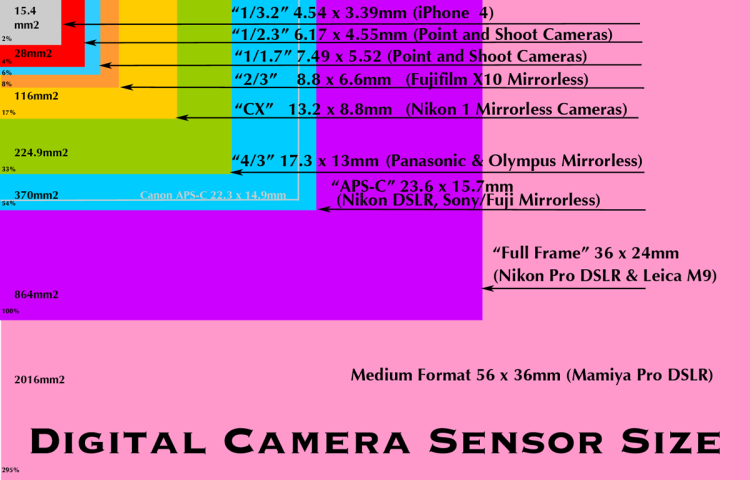
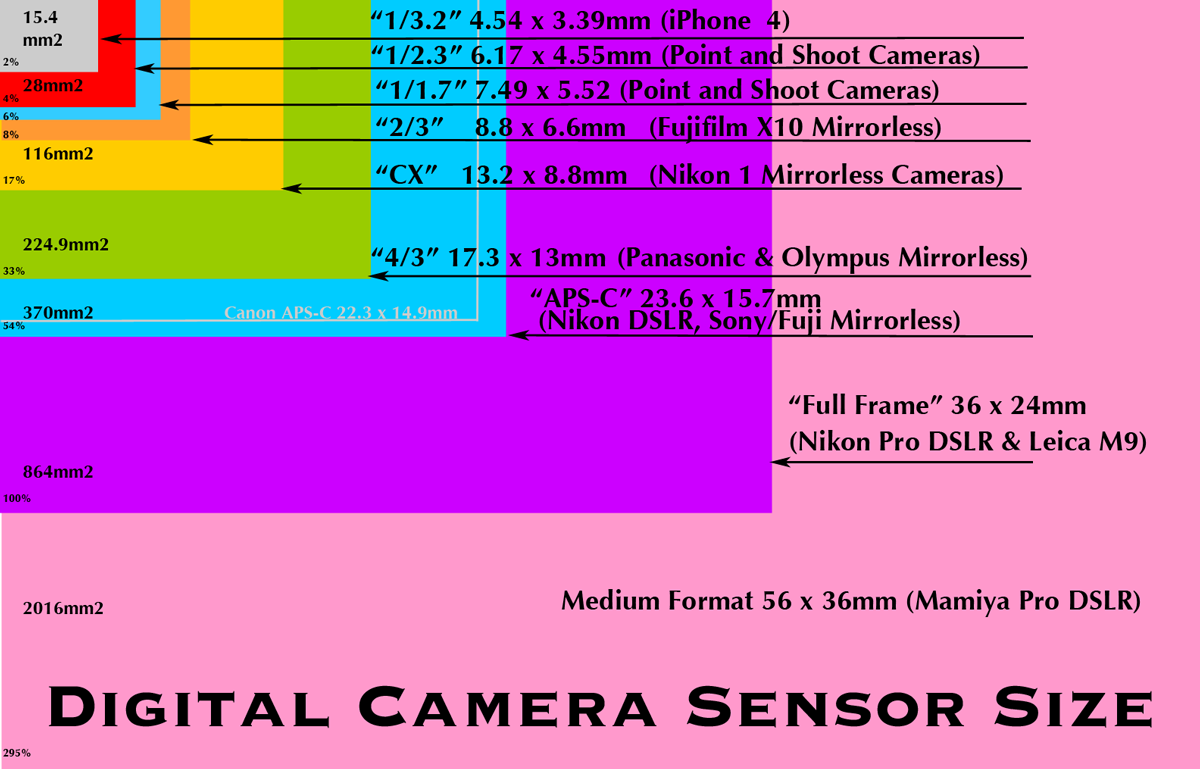
So if you have a 20 megapixel camera and it has a “full frame” sensor the pixels are much larger than on an 20 megapixel APSC sensor that is 54% the size of a full sensor. Roughly speaking the individual pixels that record light will be half the size on the APSC sensor. The chart below gives you the relationship between the sizes of the different sensors. A “full frame” sensor is usually found in most professional cameras (unless they are medium format) and the APSC sensor is found in most DSLRs or Mirrorless cameras that people pick up at your local camera store.
Sensor-Size
copyright sassamatt.com
The most revealing aspect of this chart is the percentage figure on the left hand size that shows that most point and shoot camera sensors are 4% the size of a full frame cameras and APSC cameras like the Fuji X-T1 or Nikon D7100 are 54% the size of a full sensor camera. If you own a 4/3″ camera then your sensor is 33% the size of a full sensor camera.

The Problem with Smaller Pixels

A 20 megapixel sensor can be describe as a surface on which there are 20 million small buckets, each bucket collects light (photons) and sends this sampling to a processor in the camera that then produces a picture. The smaller the buckets the smaller the sample it collects. The small the sample the more difficulty the processor has in creating an accurate image. So as the pixel size decreases less light is sampled making it more difficult to produce an accurate image. This is why larger cameras produce a clean looking photograph with accurate colour and smaller cameras produce cartoon like colours, have more noise, have more artifacts and inaccurate edges.

How Small is To Small

So how can you find a clear measurement of how big the pixels are when there are a multitude of sensor sizes and with different megapixel counts? The measurement that allows you to do this is pixel pitch. Pixel pitch is a measurement of the number of photons each pixel collects. Remember the fewer the photons, or the lower the pixel pitch number, the more the processor has to guess about the information coming from the sensor. The more guessing the camera does the more cartoony the edges and colours. Also the more guessing the more noise and artifacts that the camera introduces into your image.
You will notice that most of the professional cameras have on this list have a pixel pitch of approximately 5 or greater, which gives you some idea of a desirable pixel pitch

Conclusion

Finding out the pixel pitch of a camera you want to buy means you will be able to compare it with other cameras with different sensor sizes and megapixels. You will find that lower pixel pitches are fine for small internet photographs, but printing over 8 by 10 prints usually means you need a pixel pitch of at least 5  or more.
Keeping in mind picture quality can be effected by other things as well such as the quality of your lens, the manner in which you operate and shoot the camera, whether you shoot RAW or JPG and how you process your images. However sensor size is still key to determining the quality of your print and how big you can enlarge it.

Post Script

New sensor technology in the form of back illuminated sensors and sensors with copper substrate, can cause the pixels to gather more light.


The Great Megapixel Con

Sensor Size and Pixel Size

You can not pick up a camera or smartphone without hearing about its megapixel count and at face value you might conclude the more megapixels the better. Megapixels do tell you the resolution or sharpness of the image you will get when you post it or print it, but it does not tell you about the quality. What effects the quality is the size of each pixel on the sensor, and the smaller the sensor the smaller the pixels. As pixels get smaller the cameras colour accuracy goes down, while noise and artifacts increase.

So if you have a 20 megapixel camera and it has a “full frame” sensor the pixels are much larger than on an 20 megapixel APSC sensor that is 54% the size of a full sensor. Roughly speaking the individual pixels that record light will be half the size on the APSC sensor. The chart below gives you the relationship between the sizes of the different sensors. A “full frame” sensor is usually found in most professional cameras (unless they are medium format) and the APSC sensor is found in most DSLRs or Mirrorless cameras that people pick up at your local camera store.
Sensor-Size
copyright sassamatt.com
The most revealing aspect of this chart is the percentage figure on the left hand size that shows that most point and shoot camera sensors are 4% the size of a full frame cameras and APSC cameras like the Fuji X-T1 or Nikon D7100 are 54% the size of a full sensor camera. If you own a 4/3″ camera then your sensor is 33% the size of a full sensor camera.

The Problem with Smaller Pixels

A 20 megapixel sensor can be describe as a surface on which there are 20 million small buckets, each bucket collects light (photons) and sends this sampling to a processor in the camera that then produces a picture. The smaller the buckets the smaller the sample it collects. The small the sample the more difficulty the processor has in creating an accurate image. So as the pixel size decreases less light is sampled making it more difficult to produce an accurate image. This is why larger cameras produce a clean looking photograph with accurate colour and smaller cameras produce cartoon like colours, have more noise, have more artifacts and inaccurate edges.

How Small is To Small

So how can you find a clear measurement of how big the pixels are when there are a multitude of sensor sizes and with different megapixel counts? The measurement that allows you to do this is pixel pitch. Pixel pitch is a measurement of the number of photons each pixel collects. Remember the fewer the photons, or the lower the pixel pitch number, the more the processor has to guess about the information coming from the sensor. The more guessing the camera does the more cartoony the edges and colours. Also the more guessing the more noise and artifacts that the camera introduces into your image.
You will notice that most of the professional cameras have on this list have a pixel pitch of approximately 5 or greater, which gives you some idea of a desirable pixel pitch

Conclusion

Finding out the pixel pitch of a camera you want to buy means you will be able to compare it with other cameras with different sensor sizes and megapixels. You will find that lower pixel pitches are fine for small internet photographs, but printing over 8 by 10 prints usually means you need a pixel pitch of at least 5  or more.
Keeping in mind picture quality can be effected by other things as well such as the quality of your lens, the manner in which you operate and shoot the camera, whether you shoot RAW or JPG and how you process your images. However sensor size is still key to determining the quality of your print and how big you can enlarge it.

Post Script

New sensor technology in the form of back illuminated sensors and sensors with copper substrate, can cause the pixels to gather more light.


Best in Class 2014: Until Photokina Changes the Landscape

Conclusion
4/3″: Panasonic GM1 and Olympus OM-D series
APSC: Fujifilm X-T1
Full Frame: Sony A series

What Is Never in the Running

The chart below assumes the sensor size of 35mm or “full frame” is 100%. Using a percentage is a much more revealing way of comparing sensor size. If you look at the iPhone sensor it is 2% of the size of a “full frame” sensor, and the majority of point and shoot cameras are 4% of a “full frame” sensor. If you have a smart phone it would be pointless to have a point and shoot, so on that basis I would exclude most point and shoots. Next you would have to look at the return on investment. Point and shoots with larger sensors cost as much or more than a 4/3″ or APSC sensor cameras that are significantly larger (see chart below). So I would automatically exclude anything with a sensor smaller than 4/3″ as being a bad return on your money, as you can take the same amount of cash and buy a much larger sensor camera. Remember it is the sensor size that is most important not megapixels (lenses of course are also an extremely important issue).
So “what is out” is anything smaller than cameras with a 4/3″ sensor (33% the size of a “full sensor”). This leaves three classes of sensors: the “full frame” at 100%, the APSC sensor at 54% and the 4/3″ sensor at 33%.
Sensor-Size
@sassamatt 

Eliminating the DSLR

In the last few years a number of mirrorless cameras have emerged. They have the same size sensors as the DSLR cameras and have the same processors. In other words they produce as good and sometimes better quality photographs than DSLR cameras (DSLR cameras have a mirror that flaps up and down every time you take a shot). In most of the world the DSLR market is collapsing in favour of mirrorless cameras. In North American this shift is stalled, likely due to the confusion around the difference between these two types of cameras. The new class of mirrorless cameras are every bit as sophisticated as the DSLR. Mirrorless cameras have the same quality as DSLR and are capable of the same sophistication, but they have large advantages over DSLR cameras; they are significantly smaller, lighter and therefore more portable. Therefore I would eliminate DSLR from the mix as just not worth it, unless you want a very large studio camera.
Both Nikon and Canon have failed to significantly innovate in the mirrorless market, and given this not only would I eliminate their DSLRs from the discussion, I would simply eliminate both brands. Hopefully at Photokina this year they may do something to change this.

Mirrorless Cameras: Three Classes

The Internet Class

The 4/3″ mirrorless cameras are manufactured by two companies, Panasonic and Olympus. One great advantage of these cameras that lenses produced for either camera can be used on the other’s camera. So there is a very large set of lenses available. The draw back to these cameras is image resolution. I like to think of them as internet cameras, because image quality on this internet does not require higher resolution image quality. Don’t get me wrong they can produce stunningly crisp photographs up to 8 by 10, that would rival any larger camera. So if you are shooting for the internet or smaller prints like 8 by 10, it is hard to justify spending more on a larger camera.

The Prosumer Class

The mirrorless APSC size cameras have become very sophisticated recently and manufactures like Sony with their NEX series and Fujifilm with their X series have produced some stunning cameras. Unlike the 4/3″ cameras they seemed to have produced a camera that can produce high quality prints well beyond the 8 by 10 print size. So if you are going at some point to enlarge a print for over the fireplace you should be shooting with at least an APSC size camera.

Entry Level Professional Class

I am not going to get into the other professional class cameras such as medium format cameras and larger. The current line of full frame sensor cameras in fact are now producing resolutions that were once considered only within the capacity of a medium format camera. So in the full frame category of cameras there are only really two players Sony with their A series and Leica with their Range Finder. However Leica cameras (unlike their lenses) have not really kept pace with technological advances, they are also at, seven to eight thousand dollars, three to four times more expensive than Sony. Given that Sony make proprietary lens adaptors for Leica lenses, it is very hard to argue that Leica is worth the investment. So in this class I would suggest there is only one player Sony.
Why would you want a full frame if an APSC camera could print large as well? I think a simple answer to this is low light superiority. In other words once you start moving your ISO from 100 upward past 600 the APSC cameras start to produce poorer quality images than a full frame camera. So if you are not living in California where it is sunny all the time this is an important consideration.

So What is Best in Class

So the assumptions here are we are dealing with mirror less cameras and ones that have quality lens options. Although we have not talk about this yet, it is the lens that is the most important part of the camera. So if your camera does not have access to good lenses then it does not matter how good the camera is you will have a problem getting good quality crisp prints.

4/3″ Cameras

I would say there are really two cameras in this category that emerge as best in class and for different reasons. The Panasonic GM1 which is the smallest mirrorless, non point and shoot camera on the market. In fact it is smaller than a lot of point and shoot cameras. At $750 including the lens this camera is a real bargain and pocketable. The only draw back is it does not have a view finder.
The second camera to emerge which is larger and has a view finder, is the Olympus OM-D series of cameras. They are as large and as expensive as APSC camera and their lenses are smaller. So once equipped with a lens they can be smaller than the APSC cameras but not by much. If you are trying to read between the lines here, personally I would consider the GM1 for pocket ability but with the money you need to by an OM-D it does not make sense to me, I would spend the same money and get an APSC camera.

APSC Cameras

Here I would suggest there are only really two companies innovating in this size of camera Sony and Fujifilm. Sony’s NEX series, which is currently being rebranded into the “A” series, is smaller than the Fujifilm cameras but its lenses are larger. So in the end they are very similar in size. Price wise they are similar once you make a view finder a requirement. So what is the difference between the two.
The Sony advantage is that their lens mount is the same for the APSC sensor and the full frame sensor. So if you are one of those people who invests in lenses first, you could buy a cheap NEX and some expensive full frame lenses. However there are a number of disadvantages; the NEX series is driven using its complex menu system, rather than lots of dials on top of the camera. This slows you down when shooting, as some critical camera adjustments have to be made by accessing the electronic menu. In addition to this it uses a sensor that may at times be more prone to moire. Finally there is the issue of Lenses. Sony lenses for this series are limited in quality, so if you want quality lenses you may have to invest in some very expensive Leica lenses, or alternately very large full frame third party lenses.
Fujifilm really owns the APSC space for some very fundamental reasons. First their sensor is not a Bayer sensor like every other sensor on the market, it is an XTran sensor. This sensor increases the resolution of the camera by at least 10 percent while making moire a non issue. Second this camera is specifically designed for APSC sensors unlike Sony that uses a full frame mount. The advantage here is the lenses are smaller and much higher quality. In fact many of the lenses made for Fujifilm cameras can out resolve (are sharper) many of the high end full frame camera lenses. Third Fujifilm lenses are world class and rival Nikon glass and often out perform their lenses as well.
Finally, the newest Fujifilm camera the X-T1, can be operated almost completely without every having to go into the menu system all from the dials on top of the camera, including an ISO dial. It boosts the largest electronic view finder on the market and the fastest lenses. In these ways Sony’s APSC cameras are out classed.

Full Frame Sensor Cameras

In this category Sony owns the podium with three mirrorless cameras that address three different markets. The A7R is their 36 megapixel camera and a favourite of people who need to create very large prints with highly detail resolution. The A7 at 24 megapixels the most reasonable camera in the triad, with a price almost as cheap as the APSC high end mirrorless cameras. It is a good compromise between the high resolution of the A7R and the lower resolution of the A7s. There is one draw back to the A7 and A7R, that is not present in the A7s, the shutter is noisy as hell on the first two cameras. So if you need a quite camera the A7 and A7R are going to be a problem. Finally there is the A7s, which makes almost no noise at all when you click the shutter. The A7s is a 12.2 megapixel camera that can almost shoot in the dark. Reviewers have been raving about its ability to shoot in low light and not suffer from noise distortion. One such review said he simply put his camera on auto ISO 100-3200 and saw not real noise distortion over this range. Something only a $6000 DSLR Nikon could rival.
The Full Frame A7s and A7 camera can outperform the APSC cameras in low light. So think about churches and galleries that do not allow flash photography or those gloomy days in winter, this is where these cameras will shine.