Friday, 23 September 2016

5D Mark IV Canon Shooters Full Frame Dilemma

The New Sensor and Processor?

If you own a full frame Canon and a collection of wonderful lenses then the latest upgrades does present a dilemma. First the latest 5D Mark IV took 4 years to arrive, unlike other manufacturers who appear to be revolutionising the camera industry yearly and sometimes more frequently. Then you discover that the processor might be a tweaked Digic 6 with a "+" added on to the end of it so it can switch quickly to video. Now if your primary work is in stills then this is worrying. Which draws into question the sensor is it new or has it also just been tweaked. A quick visit to a review site and you discover yes indeed it is the best sensor Canon has ever produced, but then you discover they are still behind Nikon, Fuji and Sony in terms of dynamic range, colour and noise.
A quick comparison from the DXO testing site is found below, the X-T2/X-Pro2 have not been tested yet:

Courtesy of DXOmark

The New Autofocus and FPS

The new autofocus engine on the new Canon is 41 cross points with 61 point autofocus, but wait even Nikon's APSC camera has 153 autofocus points, Sony's mirrorless full frame AR7 II has 399 autofocus points, Fuji's X-T2 has 321 and Sony's A99 II has 399 autofocus points. Anyone who has seen the A99 presentation of a camera shooting 42 megapixels tack sharp images at 12 frames per second, would realize that Canon may well be bringing up the rear guard with their focusing technology. So we can forget even discussing the 7 frames per second of the Canon camera does even though it is 2 fps faster than last years Sony A series or the Nikon 800 series. But keep in mind that the new Nikon D500 is 10 fps and the Fuji X-T2 is 8 fps. Yes, I know these last two cameras are APSC cameras but if you look at the resolution test, especially from the X-T2 (except at extreme ISOs) it is of similar image quality.

Falling Back on the Lenses

Well, of course, the fall back here is the lenses are excellent and the lens stable is large, after all, you date your camera but marry your lenses. What could be better than shooting on Canon lenses, they have great glass? It is really more important to have good glass than anything else. So let us look at two trusted lens testing sights for an evaluation of prime lenses.

Although some of the sites have not caught up to the new lenses that have been produced over the last few years, it does seem the Canon lens are not testing as well as other brands.

How About Cost and Weight?

Well in this regard the comparisons show that the Canon kit might be the cheapest full frame kit but only by a few hundred dollars over the Sony kit. When you are spending this much money to go full frame the difference is meaningless. Especially when the Sony kit contains a better camera and some of the best glass on the market. If you are going to go full frame it would make no sense to keep investing in a new Canon camera.
If you are going to travel given the extremely high quality of the Fuji lenses it might make some sense to look at this kit, after all, the weight and price are half that of a full frame camera! A little googling will come up with a plethora of full frame pros that have gone Fuji especially for field work.

Side by Side Comparision

Here all three cameras in the same order as above with a 35mm lens attached.

Conclusion

Given the quality of the lenses, the low level of camera innovation and the quality all round compared to other choices, it would make some sense to liquidate a Canon system before the news gets around, that even Nikon is out producing better lenses and cameras. 
The good news is glass retains a high degree of value and the cost of moving over to another full frame system might be around 40% of what it might costs if you sell off your camera and lenses. Given how far ahead the mirrorless cameras are now it might make a lot of sense to buy into a mirrorless system and really there are only two choices here, Sony full frame A7 series or the Fujifilm APSC X series. 
Sony provides excellent choices of three full frame mirrorless cameras the A7S II which is the best low light camera on the market and a favourite of the video world; the A7II a 24 megapixel all purpose camera; and the world's most advanced high-resolution full frame camera the A7R II with a 42-megapixel sensor. All at prices below those of equivalent DSLRs. Not to mention the ability to use their new G master lens calibrated to a quality well above any current full frame lens or the stable of superb Zeiss Batis lenses specifically designed for the Sony A7 series.
Now if you were considering a Fuji system, which many full frame photographers are moving to because of the extremely high quality of the lenses and the X-Tran sensor which gives a boost to your resolution, then you might be able to almost do this for free. The quality of Fujifilm lenses is their best-kept secret and in most cases can run rings around the quality of full frame pro lenses.
One final note if you want to hedge you bet a simple Metabones Adaptor would allow you to keep using your Canon lenses while you explore a Sony Camera.
Canon EF Lens to E mount Smart Adapter (Mark IV)

Links


Thursday, 22 September 2016

A New Look at Sensor Size

Sensor Sizes Compared

Below I have posted three charts and a table. The first chart compares cameras with APSC size sensors or smaller, in this chart, I assume the APSC sensor is 100% and show how the others compare in terms of the percentage of square mm. The second chart compares full frame cameras sensors to smaller camera sensors assuming the full frame is 100%. The third chart follows the same format but starts with medium format cameras at 100%. The table below the charts has more specific information about cameras sensors, their size and their pixel pitch which has a big impact on image quality (IQ).
For more information on pixel pitch check out my previous post titled "The Great Megapixel Con."  


Links


Sunday, 10 July 2016

Musing on a High Quality Pocket Camera

Attempting to get a good camera into your pocket, is the holy grail for a lot of photographers, a second camera that is easy to have with you, when carrying the rig just won't work. Clearly, the best camera with you is the right camera has some real flaws when it comes to actually printing your prize photograph, especially if that camera turns out to be a smartphone. Certainly, a smartphone is all you need for the internet and those prints you pass around or put into your albums. In fact, in today's world, there are few arguments for using a point and shoot as their sensors are almost the same size as an iPhone unless of course, you don't have a smartphone.
No matter how you rationalised it, if you are going beyond an 8x10 print then you are looking at an APSC sensor or larger. Yes, I know there are a lot of people that would argue with this, claiming 4/3 or small can be printed larger than this but there is a real quality issue that is being ignored. So for me, perhaps not you, I look at cameras that have an APSC sensor or larger for my pocketable camera that gets me the quality I need.

So what is out there you ask?

There are a lot of choices of course but if you sift through the reviews carefully and examine the technical specifications. Making sure you are spending your hard earned money on the most current technology, not something that has been marketed for the last four years. Then the field narrows considerably. Clearly, the final selection is my opinion so if you have another camera you swear by please don't take it the wrong way. However, I would say that the top mirrorless cameras at this point in time are made by Fujifilm, Sony and Leica. Keep in mind neither Canon nor Nikon have innovated in this area, so their large cameras are not listed. I have also excluded the Ricoh GR II, because of reviews suggesting soft sides and excessive noise reduction application to files. One other obvious omission is the Sony A6300, a beautiful camera. However, the A6300 uses a full frame mount making the lenses larger than those of the Fuji, and therefore not very pocketable.


Comparison courtesy of CameraSize.com

Fujifilm X-70

The X-70 is perhaps the smallest of all the APSC camera and comes with a 2.8f 28mm equivalent fixed lens. It does in fact easily slip into a jacket pocket and at 16 megapixels will provide you with a fairly good print. One of the compromises, however, used to shrink this camera is the lack of a viewfinder. Fuji does make an X-T2 and X-T10 but when a 35mm equivalent lens is added they are much larger than most of these cameras. I have chosen the 35mm lens as it is a standard lens for street photography and therefore a good way to cross compare camera size. Even if you add the 28mm equivalent to these two cameras neither of them are pocketable.

Comparison courtesy of CameraSize.com


Image courtesy of Tech Toy Review


Image courtesy of Amateur Photographer

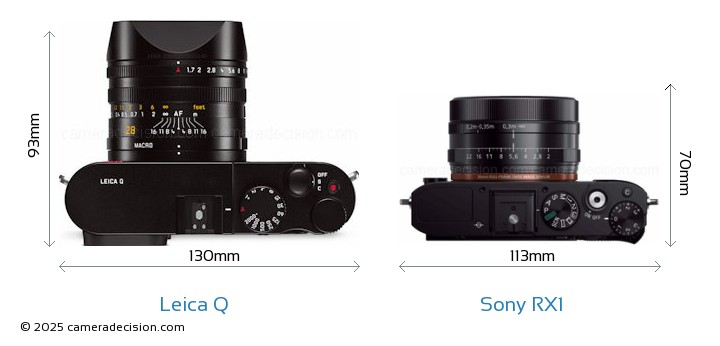
Sony RX1 series

The next smallest is a stunning camera the Sony RX1 series, whose most current iteration is the RXIR II which sports a 35mm 2f lens and creates a 43-megapixel file, on a full-size sensor. There is no doubt that this camera's image quality is excellent if not close to a medium format camera. A stunning achievement in such a small package. However, its lens, although rated very well does make the camera larger than the X-70. So not really so easy to put in a jacket pocket on a regular basis. It does have a viewfinder however but it is a pop-up viewfinder, a strange choice and somewhat awkward to use and requires a removable rubber cup. It seems to me it could simply have been built in.
Sony.ca

Leica Q

The Leica Q is a cautious camera at 24 megapixels, it is fitted with a 28mm 1.7f lens, and is a very solid and heavy camera on a full-size sensor. At 24 megapixels the pixel pitch is much better than the Sony or the Fujifilm camera, and should, as a result, render richer picture quality. The lens is also larger than the RX1R II so in terms of pocketability this camera is lens wise and body wish just too big. However, it is a beautiful camera and has some wonderful features.
Image courtesy of Mirrorlessons

Sony A7 series

The A7 series or Alpha series is like the RX1 is also 43 megapixels but unlike the RX1 series is an interchangeable lens camera. Like the RX1 it is a bold and stunning camera whose picture quality rivals that of medium format cameras. Again this camera is simply too big to fit into a coat pocket.
Sony.ca

Conclusion

For me, the only real pocketable camera is the Fujifilm's X70. The other smaller cameras, which all have full-size sensors demand larger lenses, I would say unless there is an optical revolution full-size sensor cameras can never be pocketed because of the size of the lenses needed to make full use of the sensor. Furthermore, there is only one APSC camera on the market that you can slip into the pocket at this point in time, with the exception of the Ricoh and that is the X70.
Now the one disappointment with this camera is it came out at the same time as the X-Pro 2 which now sports the new 24-megapixel sensor, yet the X70 had the 16-megapixel sensor. Clearly, if the X70 had have been outfitted with this sensor it would be flying off the selfs. If Fujifilm married the 24-megapixel camera to this sensor it would be in the pocket of every serious photographer.

If You're OK with a Smaller Sensor

There are some wonderful pocket cameras that will give you very high quality if you are either an internet photographer or print on or below the 8 by 10 size. The one I would recommend for the pocket is the Lumix LX100K. It has a fixed lens but it is a 24-70mm equivalent at 1.7-2.8f, which is a very impressively bright lens. However, its 4/3 sensor is 2/3 the size of the Fujifilm APSC sensor, but it does have a pop-up viewfinder.
Image courtesy of Lens Work Daily

Comparison courtesy of CameraSize.com


Thursday, 7 July 2016

Fujifilm X-T2

Today Fujifilm released their long rumoured and anticipated X-T2 moving from 16 megapixels to 24, and with dual SD slots. Having read the reviews the verdict is this is a great camera, perhaps the APSC camera of the year, it may well be more popular than the X-Pro 2 released early this year. This camera is a DSLR killer and the top APSC camera mirrorless camera on the market. There are also some who say moves this camera into the image quality of most full frame cameras. Certainly, if you are upgrading to more professional gear why would you buy a DSLR, you're either going to buy a Fujifilm APSC camera or a Sony Alpha series camera, depending on your budget.
After shooting extensively with the Fujifilm X-T1, Fujifilm X-Pro2 and a Nikon D800e Fujifilm's move from 16-megapixels on the traditional sensor to a 24-megapixel copper substrate sensor made a big difference. The resolution between the Nikon D800e at 36-megapixels and the X-Pro 2 at 24-megapixels on paper seems to differ significantly but when you factor in the Fujifilm lenses which in a lot of cases are sharper to the edge than the professional ED glass made by Nikon, the difference narrows considerably.
So when I look at the full frame Nikon equipment, which is twice as bulky as the Fujifilm gear I am now using the later all of the time. So for me, the new 24-megapixel world of the X-Pro2 and the X-T2 have caused me to finally decide to sell my D800e.

Fujifilm Release

Fujifilm X-T2 release document July 7, 2016. 

Reviews

Kevin Mullins "F16Click" site


Fuji X-Pro 2… Stunning!

March 3, 2016 will likely be the first roll out of the X-Pro2, heralding in a new series of X series cameras. Up until now the X series have been based on a 16 megapixel, X-Trans CMOS II sensor and a stunning range of very high quality lenses. Lenses whose performance out performs many full frame professional lenses. The X-Pro2 makes two large changes to the X line of cameras, first the resolution has moved from 16 to 24 megapixels, but just as important the aluminum substrate on the sensor has been replaced by copper. The increase resolution should have brought with it increased problems with noise and low light capacity, but a quick look at the test comparison shows just the opposite, better low light capacity and lower noise levels! The new copper substrate has pulled of a miracle, and challenged the conventional notions of how low pixel pitch impacts noise.
The X-Trans CMOS III 24 megapixel sensor still uses the unique 6 by 6 colour filter, unlike other camera sensors that use a 2 by 2 bayer colour filter, which when combined with the XF Fuji lenses produces a resolution that rivals Full Frame. Certainly it presents a real challenge to any full frame Nikon or Canon 24 megapixel camera with its superior noise and ISO performance. Especially when the physical package is so much smaller and discrete. Unlike its DSLR equivalents this camera has a number of really advantages beside size. The camera can operate in a completely silent fashion, with absolutely no noise (I mean really no noise at all). It has a jpg engine that is the best in the industry. The hybrid viewfinder, that can be toggled, allows for OVF (optical viewfinder), EVF (electronic view finder) and ERF (electronic rangefinder) viewing. The ERF has a small EVF magnification of the focal point in the lower part of the OVF to allow for accurate manual focus assistance. Lenses that out perform, edge to edge, most full frame high end lenses, especially at low f stops. Most impressive of all is, once you have set up the camera’s defaults, you really can operate the camera from the dial on top and through the read outs on either the display, EVF or Optical Viewfinder. The camera melts into the background as a camera should.
There are lots of other features that make this camera amazing, but I will leave you to explore this in the reviews I have listed below.
There has already been a large migration of professional photographer to the previous X family of cameras, and I think this new camera will accelerate this migration. If you read the threads associated with the reviews they are filled with full frame DSLR users looking for tips on how to sell of their equipment as they go all in with this new camera.
Links:

Sony A7RII Camera of the Year but Should You Buy It?

A Little History

Sony has been innovating with full frame mirrorless cameras since their first initial release of the A7 (24 megapixels) and A7R (36 megapixels) in October of 2013. At the time other than a Leica with a price point well above $5000, this was the cheapest full frame mirrorless camera on the market. Of course these two cameras had their problems with extremely noisy shutters that created camera vibration and a lack lustre stable of lenses. Even so with its more reasonable price and much smaller size and weight some early adopters began moving away from the massive full frame DSLR rigs. On big attraction was the ability to use Leica lenses through the use of a simple adaptor. After all if you could buy a full frame mirrorless with the same specifications as a D800e for less money, then this is a viable option.
Since that time they have produced a number of A7 cameras in rapid succession. First the A7s in April of 2014, a 12 megapixel camera that can almost shoot in the dark with outstanding video quality. This was followed quickly by the update A7II in November of 2014, with the first ever 5 axis sensor shifting image stabilization in a full frame camera, and they fixed the shutter noise. Then in June of 2015, they came out with what will undoubtable be called the camera of the year the A7RII. This camera not only has the 5 axis stabilization, but it has been bumped to 42 megapixels and now has the first ever back illuminated sensor in an interchangeable lens camera. I can also be set to a completely quiet electronic shutter. There is literally no camera on the market as advanced as this camera.

The Reason to Buy

The A7RII now that it is in production and has been review and tested by scores of people is proving to be a monster of a camera. Lets take a look at what you would be getting:

  • the camera’s 42.4 megapixel CMOS sensor produces better dynamic range and low noise images than the Canon’s  5Ds high resolution 50 megapixel camera.
  • the back illuminated sensor has expanded the dynamic range of the camera beyond that of other interchangeable lens camera.
  • low light ISO by .05 stops is better even than the A7s raising the maximum ISO by two stops.
  • it has the largest electronic view finder on the market today.
  • the shutter is designed for a stunning 500,000 actuations.
  • I has the five axis image stabilization on the sensor which means any lens you attach whether it be Sony or not is stabilized. The stabilization boasts a 4.5 stop gain. Reviews have reported a realistic 2 to 2.5 stop advantage over the Nikon D810, and more if the electronic shutter is not engaged.
  • the on sensor phase focus system and third party adaptors allow you to use many Canon lenses in fully automatic mode, adapters for Nikon lenses have just been released and of course there is an adaptor for Leica lenses as well.
  • the camera has 4k video so you can capture photographic stills from a video, and the video imaging is excellent.
  • there is a electronic shutter which can both eliminate vibration and make the camera completely quite when shooting.
  • there is no optical low pass filter which gives this camera a significant sharpness boost.
  • the new sensor has 399 focal-plan phase – detection auto focus which can shoot at a surprising 5 frames per second, while covering 60% of the frame. This is in addition to its 25 contrast auto focus points.
  • the camera is well connected to the the smartphone world with Wi-Fi and NFC that connect to both Android and Apple apps.
  • the focus accuracy of the camera is better than any DSLR so far on the market.
  • bracketing on this camera is excellent up to 9 images 1 EV or up to 5 images 3 EV, giving it the flexibility not found on other cameras.
  • Zeiss is now producing a line of “Batis” lenses specifically for the A7 series of cameras and they are fully integrated with the cameras automatic systems, and are very high quality.
  • the weight and size of this camera will allow you to carry for much longer periods of time than a full frame DSLR, not to mention it is more discrete.
  • Sony is now manufacturing a line of G lenses which are perhaps better than the Zeiss Batis lenses!
  • Most third party lenses can be attached to this camera using converters.

The Reason not to Buy

Nothing is ever perfect so there are some draw backs to the camera which are easily overlooked when such a stunning camera comes onto the market.

  • reviewers have reported that is really not a fast camera and that there are sluggish responses in many of its actions including powering up, reviewing images and zooming.
  • like many Sony cameras the battery life is very short and will likely mean you need to carry a number of extra batteries. In the field the camera gets 350 shots RAW + JPG. So this is perhaps half that of a DSLR but not a deal breaker, especial when the Sony is so much smaller.
  • the menu system is also typical of Sony somewhat unintuitive and more complex than necessary.
  • some people who have tested the camera have found the IBIS has completed the process of keeping the sensor clean of dust spots, but for some reason many of the spots can not be removed with a blower or a shaker.
  • the video is limited to 8 bit 420 internal and 8 bit 422 external recording so it can not do 10 bit.
  • some of the Sony lenses suffer from asymemetry problems, creating blurring in specific spots of the lens. Some reviews suggest that this is due to lapses in quality control.
  • if you need a faster camera this is not the camera for you as the increase in dynamic range and low light capacity, that is achieved by replacing the EXMOR RS (stacking sensors) with the EXMOR R (back illuminated sensor), comes at the cost of slowing the camera down to five frames per second.
  • the camera has a reasonable feel in the hand but does lack the ergonomics of other full frame cameras and is perhaps more menu oriented than cameras like the Fuji X series.
  • other DSLR have extensive third party equipment developed for them and there is an extensive used market for this equipment, this is not the case yet for Sony. So this means you can buy and sell much more easily with other systems.

Travel Considerations

When you consider travelling with the camera on an airplane this focuses you attention sharply on the differences between systems. You are not likely going to check your camera equipment where it can get stolen or damaged through improper handling. So it will be going on the plane with you along with other essentials that can not be checked. At this point you begin to realize that the camera and its associate equipment as a whole is not the same as the size of just the camera and its lens. I think the following quote from Ming Thein, which describes his thinking on this issue, describes very well the thought process photographers go through when travelling:
On top of that, frequent fliers will also be familiar with the eternal problem of airlines and weight – the A7RII and six batteries might not be lighter than a D810 and one [note he is overstating the battery needs and weight], but the Batis 85 is a third of the weight of the Otus 85, and weather sealed (even if the A7RII’s seals appear somewhat questionable). I could carry the 55 FE, 85 Batis and perhaps Voigtlander 180/4 APO together with a Q and have an extremely versatile and high quality travel kit without printing compromises. A D810-based system would require a Zacuto, two Otuses and perhaps a tripod – which raises weight by 2.5-7kg and is the difference between checking in and carrying on only.
Personally my decision on this issue would be different. For one I would want to be travelling with a much smaller package than he is considering and one that is somewhat of less value and easier to conceal. One thing that goes through my mind is what am I prepared to leave behind in my hotel room? The Sony A7RII five axis stabilization comes very close to eliminating the need for a tripod, so this is something to consider when travelling. This coupled with the 35 mm 2.8 lens makes the camera just slightly larger than some APSC cameras. So in some ways it might be an ideal travel camera.

Financial Considerations

The Street Camera Comparison in the chart below looks at the price of “streeting” the leading compact APSC and Full Frame cameras. As you can see from the chart there is quite a range in prices and quality. However with the exception of the X100t and the D810 the cameras seem to all be of a similar size.
Steet Camera Compared

Conclusion

If you own an X100t camera or a Fujifilm APSC camera, or 6000, Leica Q, D800/810 upgrading to the A7RII just to get a smaller street camera would really make no sense. If you are a landscape photographer and own any of these cameras, unless you really need the extreme detail then it really is not worth upgrading. If you need extreme detail and own a D800/810, there is not enough difference in camera IQ to really need to change unless you need really good low light performance or a smaller camera.
So if you always have to have the best and want to stay on the cutting edge of photographic technology then you should be liquidating your camera equipment to invest in this camera. It is time to take the leap. The only caveat I have here is “will another more amazing camera be released tomorrow?”
If you are a landscape or street photographer upgrading to a full frame camera from a APSC DSLR then I think the A7RII would likely be the camera to consider, it is more “streetable,” more advanced and by the time you become comfortable with the camera Leica will have sufficiently closed the gap in the high end lens arena.

Some Links for Further Reading.

Leica Full Frame Fixed Lens!

Originally Posted, Sept 7, 2015

Leica quietly announce the new “Q” full frame fixed lens camera. This 28mm camera has a f/1.7 lens, amazingly fast with an almost silent leaf shutter. The only other camera on the market that is similar is the Sony RX1 but the Q has what the RX1R failed to deliver; a range finder experience in an EVF format. In addition to this it is a Leica built camera with a Leica built and designed lens. The Sony RX1R comes in at $2999.99 CAD making it $2310.01 CAD cheaper. However when you add back the viewfinder at $649 the gap between the cameras narrows to $1660.

If one wanted to attempt to construct a similar quality with the A7 series, you could buy a A7II for $1698 US and a Zeiss Batis 25mm f2 lens for $1199.00 US. This combination would cost you $2,897 US versus the $4250 US and save you $1352 US. However, the lens would would be bigger and would have less long light capacity at f/2 and the camera would also be bigger, in addition you loose the advantages of a fixed lens system. If one was to translate that into the Canadian market the Sony package would be $1999 CAD (A7 II) plus the Batis lens at $1699 CAD est. (f/2 25mm) totalling $3698. Compared to the Q at $5310 a difference of $1612.

I think though if you were going to look at the A7 series as an alternative to this camera you would not buy the A7II with its camera noisy shutter shake problems, rather you would  be looking at the A7RII. The A7RII is silent. Here the numbers change as this would mean the A7RII plus the Batis lens would cost, $5099 CAD (est), making the difference $211. This is not really a significant amount.
I think when you consider this is a Leica Lens and a Leica camera and it is within range of the Sony cameras which are now the best buy in the market, this is significantly tempting. The jump to Leica has now become somewhat affordable, for those who want to shoot with a full frame sensor.

Some Key Features of the “Q”


  • Although the camera is not weather sealed, in a number of test with the camera have reported that it performed well under wet conditions.
  • It has a Leaf shutter which allows the camera to go up to 1/16000 of a second. It also has better access to bokeh and shallow depth of field, in different lighting conditions. A feature that is usually reserved for medium format cameras. A leaf shutter also reduces vibrations and is virtually silent, so fantastic for street and other types of photography where shutter noise is problematic.
  • The “Q” has only two ways of recording images either JPEG or JPEG + DNG. For those who want DNG only, this is not possible, however a simple firmware upgrade could change these options.
  • The Leica “Q” is simply easier it operates like a camera unlike the Sony cameras that are more like a computer with endless menus. The Leica is simple to set up and shoot.
  • Leica has decided unlike Fujifilm and Sony to provide a more realistic bracketing system, their bracketing is in graduations of up to 3 EV, in 1⁄3EV increments
  • Although the Leica does not have split screen focusing, it does have a focusing assist options and focus peaking. The focusing on this camera is quite reliable and extremely fast so unless you are a manual focus person, you may be leaving the auto focus on all the time. In terms of automatic focusing the camera has single point, tracking and continuous options.
  • The “Q” has the best low light capacity of any of Leica’s cameras to date. It also has optical stabilization which provides additional assistance in low light.
  • The quality of the LCD on the back of the camera rivals any camera on the market but with one surprise, it has a touch screen, but not only can you touch to find a focus point you can also touch and trigger the shutter! The touch screen also has double tap to zoom in and out; swipe to next image; drag and release to move around zoomed in image; swipe down to move between shoot and review and pinch to zoom.
  • In terms of the Electronic View Finder it now has the highest resolution viewfinder on the market at 3.68 million pixels.
  • Yes and the lens is in fact a Summilux-Q and specially made for the Leica “Q,” in-house from the ground up. Reviews have commented that this lens is every bit as good as the M lenses. It is also sharp corner to corner at all apertures and distances, with good bokeh.
  • The camera has a 24mp CMOS sensor designed and built exclusively for Leica. Although some reviews have suggested it is a CMOSIS or Sony sensor this is not the case but they are not saying who exactly did the manufacturing. Given that this is a Panasonic/Leica collaboration of engineers it is anybodies guess.
  • The “Digital frame selector” mode is uniquely Leica and mimics the optical rangefinder by using a function key to toggle between 28mm (24mp) 35mm (15mp) and 50mm (8mp). This function button is small button on the rear of the camera. Unlike the Leica M it shoots all the DNG files at 28mm but produces the jpg files at 28, 35 or 50. I found this a unique and very interesting solution to the fixed lens issue. Keep in mind without an anti aliasing filter the resolution is going to be slightly more than advertised.
  • The camera’s aperture is adjusted on the lens barrel including the automatic mode, the manual and automatic functions are also on the barrel, there is a dial for the shutter speed and the ISO unfortunately is accessed using a button on the rear. There are some odd things about these controls  as the aperture ring is in 1/3 stops, the shutter in full stops, the ISO is in full stops and the exposure compensation dial is in 1/3 stops. Ideally as you adjust your ISO you would want to be able to adjust by 1/3 stops. Here again a firmware upgrade could change this setting.
  • The camera also has a fantastic macro mode right on the barrel of the lens and in either mode you have a depth of field scale, should you want to do zone focusing.
  • Set on DNG and the continuous shooting will shoot at a blazing 10fps for about 12-13 shots with a fast card, with virtually no black outs before returning to live image. After this the camera shots at one shot per second.
  • Some reviews report that the Maestro II image processor seems to facilitate an excellent battery life, so in the field around 600+ shots per battery have been reported. 
  • Leica Rumours has provided a list of reviewers from which I created this summary. I have also made a few additions.

  1. The Camera Store
  2. Ming Thein
  3. Jonathan Slack
  4. Kristian Dowling (part 2)
  5. Jay Cassario
  6. Brian Hirschfeld
  7. Walkingphotographer
  8. Camerawest
  9. Reddotforum
  10. Photography Blog
  11. Dpreview (hands-on)
  12. The Verge
  13. Mirrorlessons
  14. Steve Huff
  15. Luminous-landscape
  16. Soundimageplus
  17. Henry’s Note
  18. Emily Loke
  19. Macfilos
  20. Cnet
  21. Digitalversus
  22. Bloomberg
  23. Gizmodo
  24. Techradar
  25. Focus-numerique (translation)
  26. 500px
  27. Laptopmemo